Recent Projects
Toddler’s Visual-Manual Object Exploration Is Important for Object Name Learning
with Linda B Smith, Chen Yu
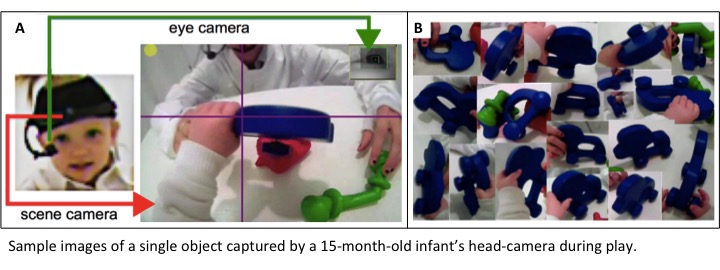
In order to map a word label to a physical object, infants must first form a mental representation of that object. The more variable the visual information infants generate about an object through play, the more opportunity they have to form a robust representation of that objects’ 3D shape. This project characterized the nature of toddler’s early visual experiences of objects and their relation to object manipulation and language abilities. Using head-mounted eye tracking, this study objectively measured individual differences in the moment-to-moment variability of visual instances of the same object, from infants’ first-person views. One finding from this research is that infants who generated more variable visual object images through manual object manipulation at 15 months of age had larger productive vocabularies six months later. This is the first evidence that image-level object variability matters and may be the link that connects infant object manipulation to language development.
The Temporal Structure of Parent Speech relates to Toddler Word Learning
with Drew Abney, Linda B Smith, Chen Yu
Much infant word-learning research has documented the contents of infants’ language inputs, however we know little about how early linguistic experiences are distributed in time or how that timing relates to infant learning. By recording parents’ speech to toddlers during naturalistic play with novel objects, and later testing infants’ comprehension of those novel objects’ names, this project characterizes the natural temporal statistics of infant language input and investigates how infants use these inherent regularities to tackle real-world learning challenges such as learning object names. One finding from this research is that parent talk to children can exhibit different types of temporal structure, and that toddlers were more likely to learn the names of objects talked about with Bursty temporal structure compared to those talked about with Periodic structure. Understanding the temporal structure of infants’ everyday language environments not only helps reveal the relevant training data for early word learning, but also provides information about the internal machinery that does the learning.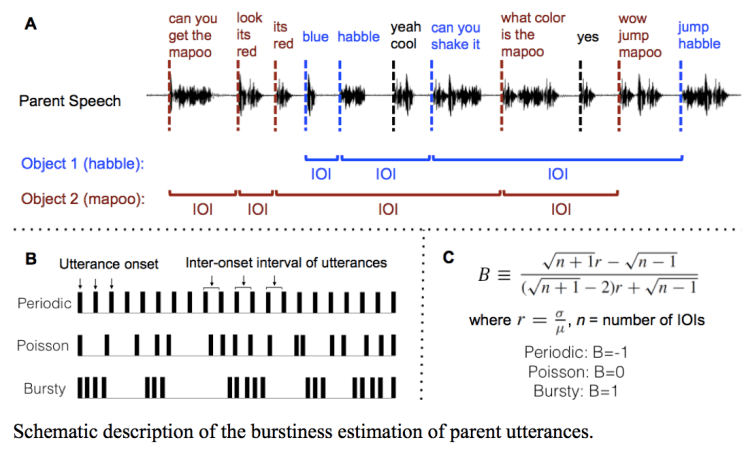
 Lauren K. Slone